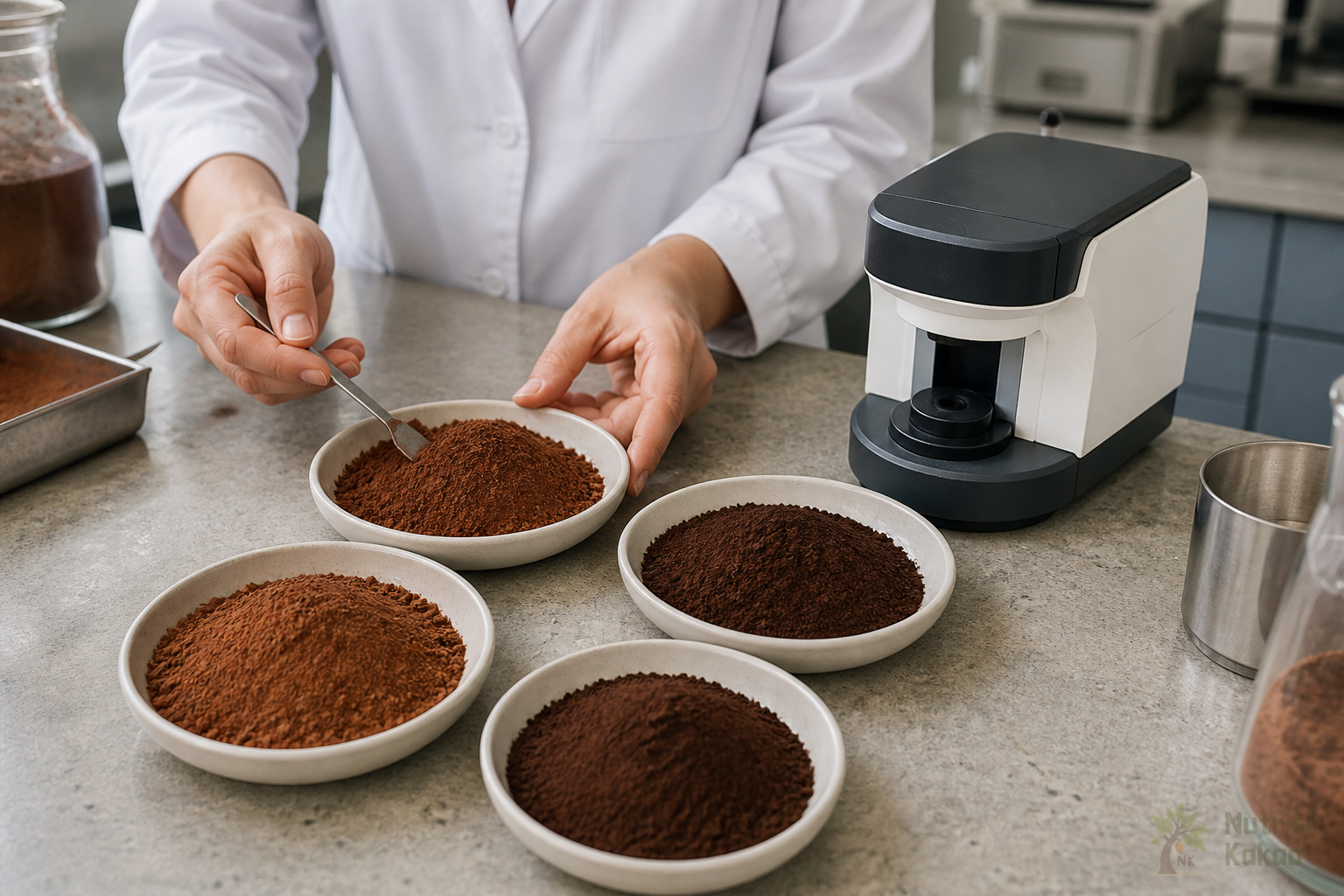
Short answer: cocoa powder color can vary because color develops across raw-material selection, roasting, alkalization, pressing, milling, blending, storage, and measurement. B2B buyers control the risk by approving a reference lot, using a shared CIE L*a*b* test method, setting application-specific tolerances, and confirming performance in the finished product.
1. Why does cocoa powder color vary between production batches?
Color can shift because of differences in cocoa beans, fermentation, drying, roasting, alkalization, pressing, milling, moisture, storage, blending, or sample measurement. Buyers should control both the manufacturing specification and the laboratory method.
2. Is darker cocoa powder always more alkalized or higher in pH?
Not necessarily. More intensive alkalization often produces a darker powder, but color is also affected by raw material, alkali type, temperature, time, aeration, particle size, and other process conditions. pH and color should be specified and tested separately.
3. What do L*, a*, and b* mean in a cocoa powder specification?
L* describes lightness, a* describes the green-to-red axis, and b* describes the blue-to-yellow axis in the CIE L*a*b* color space. Together they provide a more objective color target than descriptions such as dark brown or reddish brown.
4. What is Delta E, and what limit should a cocoa buyer use?
Delta E is a numerical color difference between a reference and a sample. There is no universal cocoa powder acceptance limit. Buyer and supplier should agree on the formula, measurement method, approved reference, and tolerance after checking repeatability and finished-product visibility.
5. Should buyers measure dry cocoa powder or the finished application?
Both. Dry-powder measurement is efficient for routine incoming control, while an application test confirms the result after cocoa interacts with fat, sugar, protein, water, heat, mixing, and product thickness.
6. Why can two laboratories report different color values for the same cocoa lot?
Powder presentation and instrument settings matter. Differences in cup type, fill depth, compaction, surface leveling, calibration, geometry, illuminant, observer setting, conditioning, and number of readings can change the result.
7. How should a new cocoa powder color standard be approved?
Approve a physical reference lot, document the complete measurement method, compare multiple commercial lots, and run a controlled plant trial. Keep sealed retained samples with both buyer and supplier for later investigation.
8. What color information should appear on a cocoa powder CoA?
When color is a critical specification, the CoA should identify the lot and report the agreed L*, a*, and b* values or other approved color metric. The underlying contract should define the test method, tolerance, sampling plan, and whether Delta E is calculated.
9. Can a buyer approve an out-of-range lot if the finished product still looks correct?
Only through a documented concession process. First confirm the measurement, quarantine the lot, compare retained samples, and run the agreed application test. Record who approved the deviation and whether future deliveries must return to the original range.
10. Are photos or visual swatches enough to approve bulk cocoa powder color?
No. Photos and swatches are useful for screening, but lighting, camera processing, displays, sample depth, and human vision make them unreliable as the only acceptance method. Use instrumental data plus an application trial for commercial approval.
Buyer checklist
- Approve and retain a sealed physical reference lot.
- Agree on instrument settings and powder sample preparation.
- Specify L*, a*, b*, the Delta E formula if used, and related pH and moisture controls.
- Validate the tolerance with multiple lots and the production formula.
- Require lot-level results and a documented out-of-spec process.
For the full quality-control workflow, read the cocoa powder color consistency guide. If you need a reference sample for an industrial application, request a sample and technical data.